Page 3 - Bayaz Noor-ud-Din in English: The First English Translation of This Classical Unani/Hikmat (Greco-Arab) Medical Work
By Hazrat Hakeem Noor-ud-Deen, Khalifatul Masih I (ra) (1841–1914)
English Translation:
Nabila Amatul Naseer, M.Phil (Human Nutrition and Dietetics)
Syeda Munazza Ahmad, M.Phil (Sociology)
Medical Editor & Project Lead:
Qaisar J. Qayyum, MD

CAUTIONBayaz Noor-ud-Din is a historical medical work based on material dictated more than a century ago. Over the years, the text has passed through handwritten manuscripts, copies, transcription, typesetting, and subsequent publication. During this process, scribal, spelling, grammatical, punctuation, transcription, or printing errors may have entered the available text. In some places, missing or misplaced punctuation, variations in the spelling of medicines and herbs, or difficult Arabic, Persian, Urdu, and Unani/Hikmat terminology may significantly affect interpretation. Although considerable effort is being made to identify and correct such issues during translation and editorial review, complete accuracy of the historical source text, its interpretation, or the identification of every medicine, herb, preparation, dosage, and medical term cannot be guaranteed. This translation is published primarily for historical, educational, and scholarly purposes. It should not be used independently as a guide for diagnosis, treatment, preparation of medicines, or self-medication. Anyone considering the practical use of any remedy or treatment described in this work should first verify the original text, ingredients, identity, dosage, preparation, and suitability with an appropriately qualified Hakeem/Unani practitioner, Ayurvedic practitioner where applicable, physician, pharmacist, or other relevant healthcare professional. Readers are responsible for obtaining appropriate professional verification before acting upon any medical information contained in this historical work. The translators, editors, contributors, and publisher cannot accept responsibility for harm, loss, or adverse consequences resulting from the interpretation or practical use of the historical remedies or medical information presented in this publication. |
Note to the Reader
This page is presented as a working translation of the original Byaz Noor-ud-Din. The aim is to preserve the original wording, terminology, remedies, doses, and arrangement as faithfully as possible while making the text understandable in modern English. Historical Unani/Hikmat terms are retained in parentheses, and verified English and botanical names are added where appropriate.
Text shown in red indicates a word, reading, translation, botanical identification, dosage, or historical medical term that remains uncertain and requires further research or verification. In such cases, the original wording has intentionally been preserved rather than replaced by an unsupported assumption. Red text therefore does not necessarily indicate an error; it identifies an item still under editorial review.
The medical concepts and treatments on this page reflect the historical text and medical understanding of its time and should not be interpreted as contemporary medical advice.
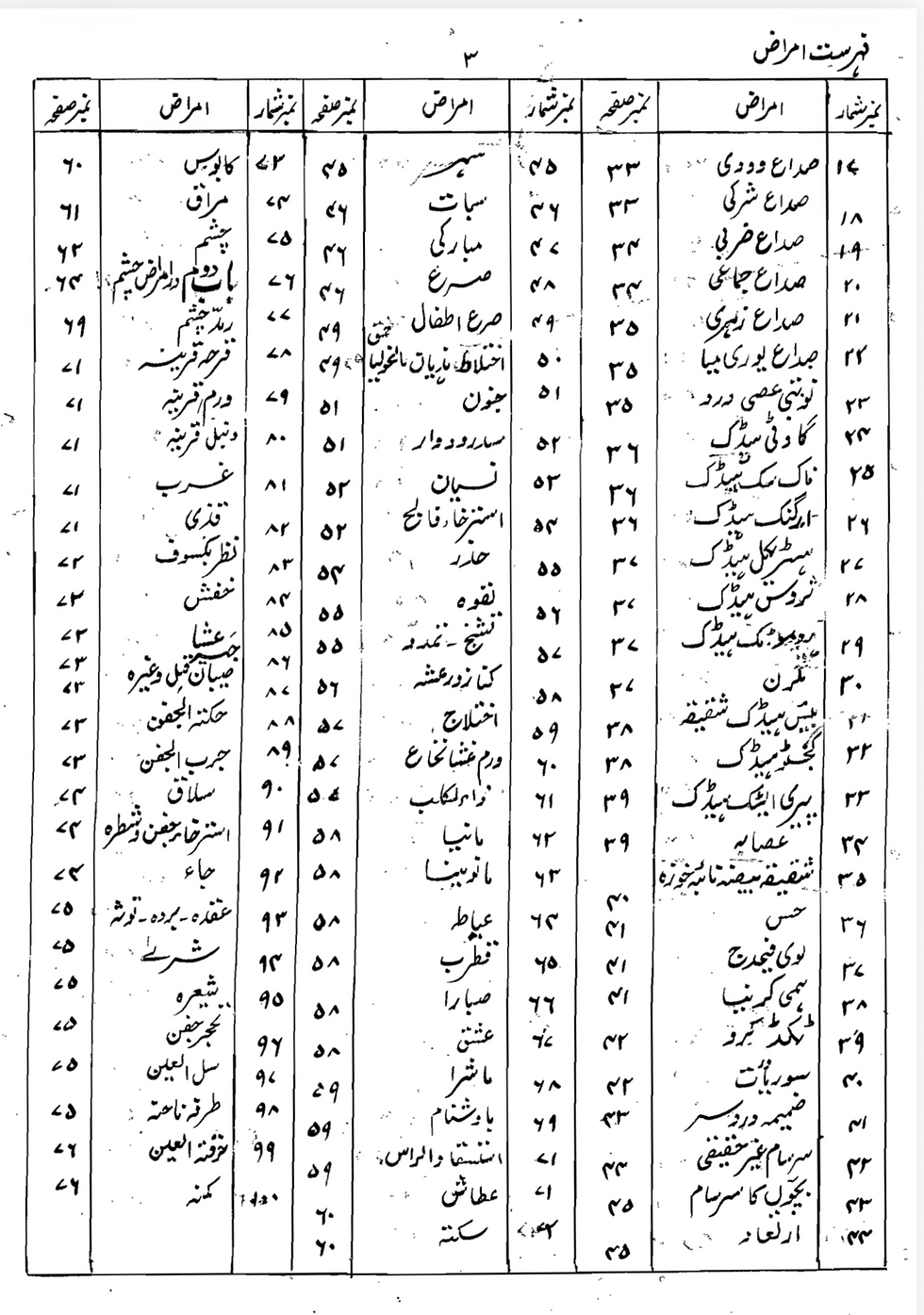
Index of Diseases, (Fihrist-e-Amraz), Bayaz-e-Nuruddin, Part One, Page 3
Format: modern correspondence, where one exists | English rendering | Roman Urdu | original Urdu. "In part" means the modern term corresponds to only some of what the historical term describes; the two overlap but are not identical. "No direct modern equivalent" means the Bayaz describes the condition on its own Unani terms and no modern label has been imposed.
17. Headache with nasal myiasis, in part | Verminous Headache (from nasal worms) | Suda-e-Dudi | صداعِ دودی
18. Referred (secondary) headache | Sympathetic Headache | Suda-e-Shirki | صداعِ شرکی
19. Post-traumatic headache | Traumatic Headache | Suda-e-Zarbi | صداعِ ضربی
20. Headache associated with sexual activity | Coital Headache | Suda-e-Jima'i | صداعِ جماعی
21. Headache attributed to envenomation | Headache from Venomous Bites | Suda-e-Zahri | صداعِ زہری
22. Headache attributed to uraemia (renal failure) | Uraemic Headache | Suda-e-Uremia | صداعِ یوری میا
23. Paroxysmal neuralgia | Intermittent Neuralgic Pain | Naubati Asabi Dard | نوبتی عصبی درد
24. No direct modern equivalent | Gouty Headache | Gouty Headache | گاؤٹی ہیڈک
25. Headache attributed to a substance | Toxic Headache | Toxic Headache | ٹاکسک ہیڈک
26. Headache attributed to intracranial disorder | Organic Headache | Organic Headache | آرگنک ہیڈک
27. Functional (psychogenic) headache, in part | Hysterical Headache | Hysterical Headache | ہسٹریکل ہیڈک
28. Tension-type headache, in part | Nervous Headache | Nervous Headache | نروس ہیڈک
29. Myofascial or cervicogenic headache, in part | Rheumatic Headache | Rheumatic Headache | ریومیٹک ہیڈک
30. Migraine | Migraine | Migraine | مگرن
31. Migraine with vomiting, in part | Bilious Headache, Hemicranial Type | Bilious Headache Shaqiqa | بلیئس ہیڈک شقیقہ
32. Vascular (congestive) headache, in part | Congested Headache | Congested Headache | کنجسٹڈ ہیڈک
33. Headache attributed to cranial periostitis | Periostitic Headache | Peri-etik Headache | پیری ایٹک ہیڈک
34. Trigeminal neuralgia; frontal headache, in part | Neuralgia of the Facial Nerve Branches (brow, upper jaw, lower jaw) | Isaba | عصابہ
35. Migraine | Hemicrania: Pain Shifting Between Sides, Front and Back | Shaqiqa | شقیقہ
36. Chronic daily headache, in part | Long-standing Pain of the Whole Head | Baiza | بیضہ
37. Unilateral headache, in part | Pain on One Side of the Head | Nashiba | ناشبہ
38. Tension-type (band-like) headache, in part | Pain Encircling the Head | Khuza | خوذہ
39. Scalp paraesthesia, in part | Prickling, Itch-like Sensation in the Head, Relieved by Pressure | Hiss | حس
40. Pandiculation and yawning, in part (Unani: Kathrat al-Tamatti, Tatha'ub) | Yawning, Stretching and Lassitude from Bodily Fullness | Luvi Fidaj (possibly from English "fidgets") | لوی فیدج
41. Migraine | Hemicrania | Hemicrania | ہمی کرینیا
42. Trigeminal neuralgia | Tic Douloureux | Tic Douloureux | ٹکڈ لرو
43. Frontal sinus headache, in part (Ayurveda: Suryavarta) | Headache Rising and Falling with the Sun | Suryavart | سوریاورت
44. Secondary headaches | Addendum on Headache: Secondary Causes | Zamima-e-Dard-e-Sar | ضمیمۂ دردِ سر
45. Secondary (symptomatic) delirium; meningism, in part | False Sirsam | Sarsam-e-Ghair Haqiqi | سرسامِ غیر حقیقی
46. Meningitis; encephalitis, in part | True Sirsam: Inflammation Within the Head; phlegmatic form called Lethargus | Sarsam-e-Haqiqi | سرسامِ حقیقی
47. Infant dehydration (sunken fontanelle), in part | Childhood Sirsam | Bachchon ka Sarsam | بچوں کا سرسام
48. Tremor; involuntary movements, in part | Trembling: Involuntary Shaking of Hand, Foot or Head | Irti'ad | ارتعاد
49. Insomnia | Morbid Wakefulness | Sahar | سہر
50. Coma; stupor, in part | Morbid Deep Sleep | Subat | سبات
51. Febrile illness with miliaria crystallina (sudamina), in part | Childhood Fever with Drowsiness and Pearl-like Eruptions | Mubaraki | مبارکیمبارکی
52. Epilepsy | Epilepsy | Sar' | صرع
53. Epilepsy of childhood | Childhood Epilepsy | Sar'-e-Atfal | صرعِ اطفال
54. Delirium; melancholia; dementia, in part | Mental Confusion, Delirium, Melancholia, Foolishness | Ikhtilat, Hazyan, Malikhuliya, Humq | اختلاط، ہذیان، مالیخولیا، حمق
55. Insanity; psychosis, in part | Madness | Junun | جنون
56. Orthostatic dizziness; vertigo | Darkening of Vision on Rising, and Vertigo | Sadar o Duwar | سدر و دوار
57. Amnesia | Loss of Memory | Nisyan | نسیان
58. Flaccid paralysis (atony); hemiplegia | Flaccidity of an Organ or Limb; Hemiplegia | Istirkha, Falij | استرخاء، فالج
59. Numbness | Numbness | Khadar | خدر
60. Facial palsy | Facial Paralysis | Laqwa | لقوہ
61. Spasm, cramp, convulsion | Contraction (pulling) of a Limb; in the hands and feet called 'Iqal | Tashannuj | تشنج
62. Tonic rigidity (muscle tension in full extension) | A Limb Remaining Rigidly Straight | Tamaddud | تمدد
63. Tetanus | Tetanus | Kuzaz | کزاز
64. Tremor | Tremor | Ra'sha | رعشہ
65. Fasciculation, in part | Twitching (involuntary quivering of a muscle or limb) | Ikhtilaj | اختلاج
66. Spinal meningitis | Inflammation of the Spinal Membranes | Waram-e-Ghisha-e-Nukha' | ورمِ غشائے نخاع
67. Cynanthropy (clinical zoanthropy) | Canine Madness: Playful Cheer Turning to Striking and Abuse | Da' al-Kalb | داء الکلب
68. Mania | Mania | Mania | مانیا
69. Monomania | Monomania | Monomania | مانومینیا
70. Dementia, in part | Gradual Decline of the Faculties, Preceded by Obsessive Striving | Ubata | عباطہ
71. Clinical lycanthropy | Lycanthropy | Qutrub | قطرب
72. Mania with pressured speech or wandering, in part | Madness of Excessive Talking or Walking | Sabara | صبارا
73. Erotomania; obsessive love, in part | Lovesickness | Ishq | عشق
74. Erysipelas of the face (Unani: Mashara) | Sudden Facial Swelling from Boiling Bilious Blood | Mashra | ماشرا
75. Facial swelling (angioedema, erysipelas), in part | Leprosy-like Swelling of the Face | Badshanam | بادشنام
76. Hydrocephalus | Hydrocephalus | Istisqa' al-Ra's | استسقاء الراس
77. Encephalitis in children with polydipsia, in part | Hot Brain Inflammation of Children, with Intense Thirst | Utash | عطاش
78. Apoplexy; catatonic stupor, in part | Sudden Loss of Sensation and Movement of the Whole Body; the Patient Lies as if Dead | Sakta | سکتہ
79. Nightmare (incubus); sleep paralysis, in part | Nightmare: Feeling Pressed Down in Sleep | Kabus | کابوس
80. Hypochondriasis, in part | Hypochondriacal Melancholia Arising from the Viscera | Maraq | مراق
81. Anatomy of the eye | The Eye (introductory section) | Chashm | چشم
82. Chapter Two: Diseases of the Eye | Bab-e-Duvvum dar Amraz-e-Chashm | باب دوم در امراضِ چشم
83. Acute conjunctivitis | Ophthalmia | Ramad-e-Chashm | رمدِ چشم
84. Corneal ulcer | Corneal Ulcer | Qarha-e-Qarniya | قرحۂ قرنیہ
85. Keratitis | Inflammation of the Cornea | Waram-e-Qarniya | ورمِ قرنیہ
86. Corneal abscess | Corneal Abscess | Dubaila-e-Qarniya | دبیلۂ قرنیہ
87. Lacrimal fistula | Lacrimal Fistula | Gharab | غرب
88. Ocular foreign body | Foreign Body in the Eye | Qazi | قذی
89. Solar (eclipse) retinopathy | Eye Injury from Gazing at an Eclipse | Nazar ba-Kusuf | نظر بکسوف
90. Photophobia; day glare | Aversion to Light | Khafash | خفش
91. Nyctalopia | Night Blindness | Asha | عشا
92. Hemeralopia | Day Blindness | Jahar | جہر
93. Pediculosis of the eyelashes | Nits and Lice of the Eyelashes | Sibyan, Qirdan, Qamqam, Qaml | صیبان، قردان، قمقام، قمل
94. Eyelid pruritus (allergic or contact dermatitis, blepharitis), in part | Itching of the Eyelid | Hikkat al-Jafn | حکۃ الجفن
95. Trachoma, in part | Granular Roughness of the Eyelids, with Itching | Jarab al-Jafn | جرب الجفن
96. Blepharitis; tarsitis | Blepharitis | Sulaq | سلاق
97. Ptosis; lagophthalmos | Drooping of the Lid, and Its Opposite (a lid that cannot close) | Istirkha-e-Jafn o Shatra | استرخائے جفن و شترہ
98. Matted, crusted eyelashes (meibomian gland dysfunction, blepharitis); chalazion, in part | Hardening and Matting of the Eyelashes | Hija' | حجاء
99. Chalazion; eyelid papilloma, in part | Lid Nodule, Chalazion, Black Wart, White Warts, Wen | Uqda, Barda, Tutha, Sa'alil, Sil'a | عقدہ، بردہ، توثہ، ثآلیل، سلع
100. Urticaria of the eyelid | Urticaria (also called Las'-e-Magas, fly sting) | Shari | شری
101. Hordeolum | Stye | Sha'ira | شعیرہ
102. Tarsal induration (as in trachoma), in part | Hardening of the Eyelid | Tahajjur-e-Jafn | تحجرِ جفن
103. Phthisis bulbi, in part | Wasting of the Eye | Sill al-Ain | سل العین
104. Ecchymosis of the eyelid conjunctiva; pterygium | Blood Spot and Pterygium | Tarfa aur Nakhuna | طرفہ اور ناخنہ
105. Burning eyes (ocular irritation, dry eye), in part | Burning of the Eye | Harqat al-Ain | حرقۃ العین
106. Dry eye with foreign-body sensation, in part | Grittiness of the Eye on Waking | Kumna | کمنہ
REFERENCE SOURCES FOR TERMINOLOGY Disease nomenclature WHO International Standard Terminologies on Unani Medicine. World Health Organization, Geneva, 2023. ISBN 9789240064959. Licence: CC BY-NC-SA 3.0 IGO. https://www.who.int/publications/i/item/9789240064959 Standard Unani Medical Terminology. Central Council for Research in Unani Medicine (CCRUM), Ministry of Ayush, Government of India. Prepared under a collaborative programme of CCRUM and WHO for Traditional Medicine. https://ccrum.res.in/writereaddata/UploadFile/Standard%20Unani%20Medical%20Terminology_1430.pdf National Ayush Morbidity and Standardized Terminologies Electronic (NAMASTE) Portal, Ministry of Ayush, Government of India. Standardized terminologies and national morbidity codes for Ayurveda, Siddha and Unani, dual-coded with WHO ICD-10 and ICD-11. https://namaste.ayush.gov.in/about-namaste-portal International Classification of Diseases, 11th Revision, Chapter 26 Module 2 (TM2). World Health Organization. https://icd.who.int/browse11 Unani Medicine World, Unani Terminology. An online index presenting the WHO standard Unani terms individually, with their WHO term codes (UMA numbers), definitions and English equivalents. https://www.unanimedworld.com/unani-terminology Language Rekhta Dictionary (Urdu, Hindi and English). Used for Urdu readings and for the everyday Urdu sense of terms. https://www.rekhtadictionary.com Materia medica and pharmacopoeia Unani Pharmacopoeia of India. Pharmacopoeia Commission for Indian Medicine and Homoeopathy (PCIM&H), Ministry of Ayush, Government of India. https://www.portal.pcimh.gov.in Medicinal plants database. CCRUM, Ministry of Ayush, Government of India. https://ccrum.res.in/ViewData/Multiple?mid=1640 NOTE ON THE USE OF THESE SOURCES Each heading in the index has been checked against its definition in the chapter text of the Bayaz, and the author's own definition takes precedence. Terms were then compared with the WHO standard Unani terminology. Where the WHO definition differs from the Bayaz (for example ʿIṣāba, Kumna and Sakta), the Bayaz's meaning is given first and the WHO equivalent is noted alongside it. Where a modern equivalent covers only part of the historical term, it is marked "in part". Where no modern equivalent exists, this is stated, and no modern label has been imposed. Terms that could not be identified in any available source, such as Lūwī Fīdaj and Bādshanām, are shown in red and remain under editorial review. |
TRANSLATION AND EDITORIAL CREDITS
Original Work
Hazrat Hakeem Noor-ud-Deen, Khalifatul Masih I (ra) (1841–1914)Bayaz Noor-ud-DinEminent Unani physician and former Personal Physician to His Highness the Maharaja of Kashmir
English Translators
Nabila Amatul Naseer, M.Phil
Nutritionist and Dietitian
Syeda Munazza Ahmad, M.Phil
Sociologist, Researcher, and Academic Writer
Project Lead, Scholarly and Medical Editor
Qaisar J. Qayyum, MD
Chief Editor, Noor Journal of Complementary and Contemporary Medicine (NJCCM)
ACKNOWLEDGMENT
The English translation of Bayaz Noor-ud-Din is a collaborative project undertaken to preserve and make accessible to English-language readers the historical Unani/Hikmat (Greco-Arab) medical writings of Hazrat Hakeem Noor-ud-Deen, Khalifatul Masih I (ra).
The translated text undergoes scholarly and medical editorial review, including comparison with the original Urdu text; clarification of difficult or archaic Urdu, Persian, Arabic, and Unani/Hikmat terminology; review of historical medical concepts; research and verification of medicinal substances and botanical identities; and revision for accuracy, clarity, consistency, and readability while preserving the meaning and arrangement of the original work.
Particular care is taken not to impose modern interpretations where the historical text does not support them. Where the meaning, reading, or botanical identity of a historical term cannot be established with reasonable confidence, the original terminology is retained or identified for further review rather than replaced by an unsupported interpretation.
Bayaz Noor-ud-Din Project Team
The Bayaz Noor-ud-Din Project Team serves in an advisory and collaborative capacity. Team members contribute through discussion of difficult passages, consideration of alternative interpretations, and input on linguistic, historical, medical, Unani/Hikmat, botanical, and editorial questions.
Team members have contributed both through group discussions and by providing direct feedback, which, where appropriate, has been incorporated into the translation and editorial revisions.
The Project Team's role is distinct from that of the two English translators, who are separately identified and credited above.
USA
Dr Abid and Dr Ayesha Haq, Snohomish, WA
Dr Haroon Akhtar, Maryland
Dr Shazli Naseer
Dr Imtiaz Chaudary
Malik Abdullah
Munawar Ahmad Saqib, New Jersey, USA
Sharif Ahmad, Atlanta, GA
Dr Almas Nasar, Dallas, TX
Bilal Ahmed
Canada
Mazhar
Qasid Ahmad Bajwa
Harisah Mehmood
Pakistan
Faizan
Nabila Amatul Naseer, Chenab Nagar
Syeda Munazza Ahmad, Multan
United Kingdom
Dr Ismaeel Mohammad
Dr Qasid Ahmad Bajwa,
Scunthorpe
Australia
Dr Mohammad Younus
Dr Aamir Mahmood
Ireland
Dr Aida Nasar Khan — Dublin
United Arab Emirates
Dr Sulaiman Ahmad — Dubai
Nepal
Nasir Ahmad Bhatti
FINANCIAL SUPPORT ACKNOWLEDGMENT
This translation project has been made possible through the generous financial support of Ahmadi individuals from the NJCCM WhatsApp group who provided funding toward the cost of translating and preparing Bayaz Noor-ud-Din for English-language publication.
We gratefully acknowledge their financial support in helping preserve this important historical work and make it accessible to a wider readership.
Project Funding
Financial supporters are listed in the order in which their contributions were received.
Sharif Ahmad, USA
Munawar Ahmad Saqib, New Jersey, USA
Dr Qaisar J. Qayyum, Edmond, OK, USA
Dr Amatulah, USA
Dr Abid Haq & Ayesha Haq, Snohomish, WA, USA
Professor Aftab Ahmad & Mrs Neena Ahmad, USA
Dr Aamir Mahmood, Australia
Mubashir Ahmed, Huntley, IL, USA
Bushra Begum, RN, USA
Dr Munawar Malik, USA
Dr Amina Tariq, USA
Dr Nasira Malik, USA
Dr Aida Nasar Khan, Dublin
Dr Almas Nasar, Dallas, TX
Dr Ghafoor Manan, UK
Donors wishing to remain anonymous are gratefully acknowledged without being named.
Published by
Noor Journal of Complementary and Contemporary Medicine (NJCCM)

Comments